April 16–18, 1989 – The Square fills early
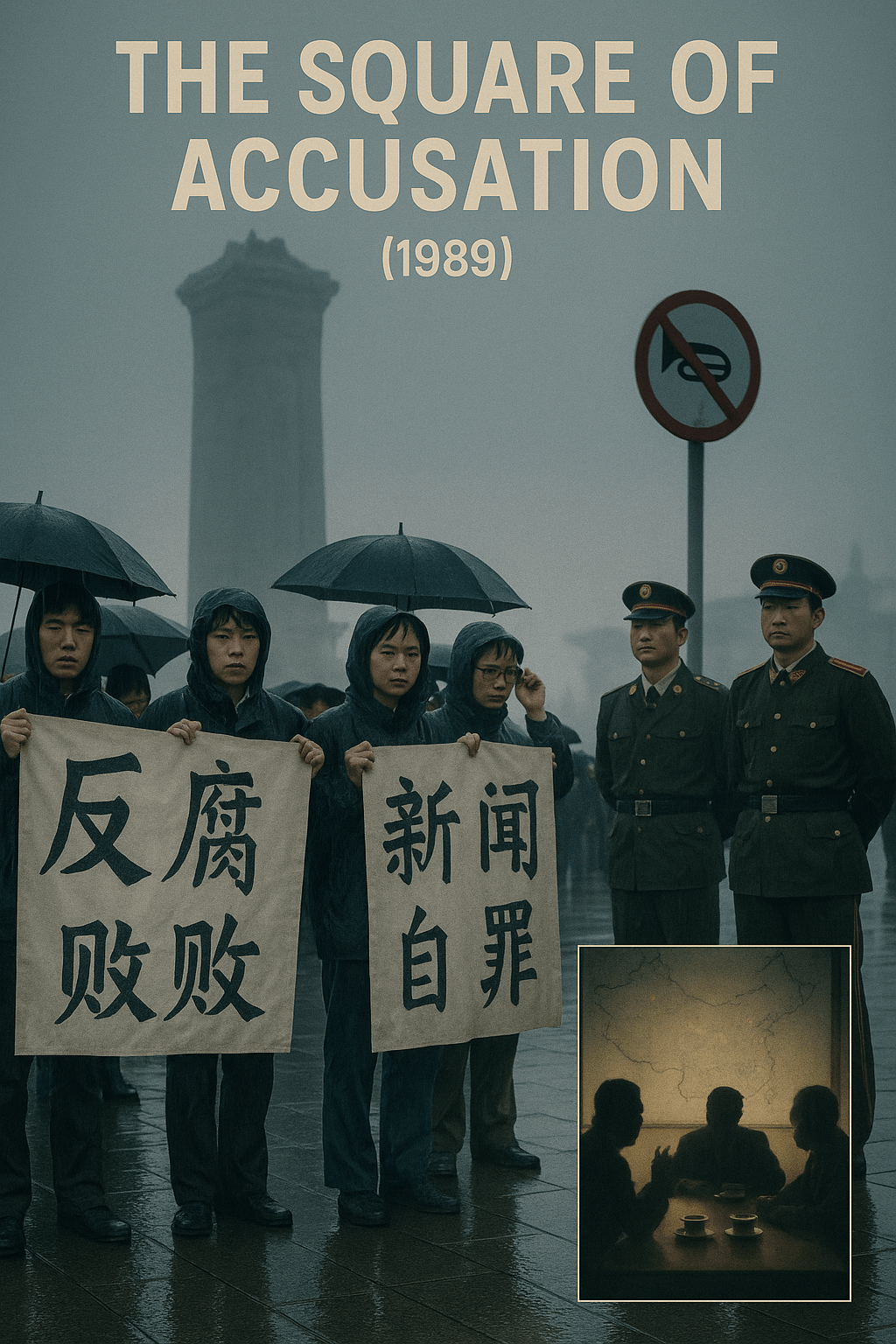
The day after Zhang Weiguo’s funeral in Tianjin, a cold rain slicked the flagstones of Tiananmen. By noon on the 16th, students from Beida and Tsinghua were already sitting cross-legged in the drizzle. Their banners were sharper than in our real history — fewer elegiac poems, more hard demands:
- 反腐败! (Down with corruption!)
- 新闻自由! (Press freedom!)
- 真相无罪! (Truth is no crime!)
The absence of mourning portraits for Hu Yaobang gave the gathering an edge. There were no flowers, no ritual mourning — this was not a vigil, it was an accusation.
Every night, the Beijing municipal party secretary sent a summary to Hu: student numbers, slogans, leaflets. Hu’s reply was the same each time:
“No violence. Keep them talking. Keep the foreign cameras away.”
In his study that evening, Deng Xiaoping sat with Bo Yibo. His voice was low:
“They see Hu as their man. That puts him in danger — and me too.”
Bo only stirred his tea, letting the comment hang.
April 19 – The Pyongyang proposal
That afternoon, Wang Zhen and Peng Zhen walked into Deng’s study together, a rare joint appearance. Wang did most of the talking:
“Send Hu to Pyongyang. It’s the treaty anniversary. Solidarity with a socialist brother. Let Zhao handle the economic mess here.”
The public reason: a diplomatic goodwill visit.
The private aim: get Hu out of Beijing, sever the visual link between him and the students.
Deng’s fingers drummed the armrest. He knew the symbolism — a General Secretary abroad while the capital seethed would look like flight. But Wang pressed:
“While he sits here, they grow bolder. Let him wave at crowds in Pyongyang instead.”
Deng didn’t say yes. He didn’t say no. He just reached for his pipe.
April 20–22 – The hottest meeting yet
The Standing Committee met in Huairen Hall. The curtains were drawn, the air heavy with cigarette smoke.
Wang Zhen opened:
“The situation is spreading. If the youth think they have a friend in Zhongnanhai, they will not stop.”
Hu Yaobang replied evenly:
“They have grievances we can address — corruption, abuse of power. To leave now would make me look like I am running away from them.”
Zhao Ziyang:
“A foreign visit could be seen as diplomacy… or as avoidance. The message matters more than the itinerary.”
Bo Yibo, leaning toward Deng:
“If he stays, they’ll think they can pull him into making promises. That’s dangerous.”
Hu said nothing further. His eyes moved from one face to another, as if memorizing the battle lines.
Finally, Deng spoke:
“Hu will decide for himself. But the Party will not be seen as running from its youth.”
Hu stayed. The conservatives walked out tight-lipped.
April 23–25 – The rumor spreads
With Hu still in Beijing, whispers spread that he had personally blocked an order to clear the Square. No one could prove it, but no one doubted it. It gave Hu a symbolic role he never publicly claimed.
By the 25th, protest banners in Shanghai, Xi’an, and Chengdu carried Zhang Weiguo’s name alongside “Open Trials for the Corrupt”.
In Wang Zhen’s office, aides brought in maps with red pins marking cities where students were marching. He stared at them for a long time before saying, “This is how things start. And then we lose the army.”
April 26 – The editorial that wasn’t
In our real history, April 26 saw the People’s Daily label the protests “turmoil.”
Here, the conservatives lacked Li Peng’s premiership voice in the State Council, so the final draft was softened. Under Hu’s influence, the front page carried:
- An acknowledgment that corruption was “a serious wound to the Party’s flesh.”
- A call for students to return to class so “grievances may be addressed in an orderly way.”
- No mention of “turmoil.”
It was intended as an olive branch. Students read it as a stalling tactic.
April 27 – The march
Tens of thousands streamed through Beijing’s broad avenues. Bystanders clapped, handed out water. Police, following Hu’s orders, kept their distance.
That night, Deng and Hu shared tea. Deng’s voice was tired:
“You’ve bought yourself time, but not the Party. They smell weakness.”
Hu met his gaze:
“If they smell justice instead, maybe we win them.”
Deng didn’t answer.
April 30–May 3 – The movement grows
May Day was hollow — the official parade dwarfed by the crowds in the Square. Small groups of workers arrived, carrying banners of their own. This was the conservatives’ nightmare: students plus workers meant politics could leave the campuses entirely.
Zhao proposed a televised forum with student leaders. Hu backed him. Wang Zhen snapped:
“Talking to them is surrender. They’ll demand more.”
May 4, 1989 – The turning point
The 70th anniversary of the May Fourth Movement brought a human tide into the Square. The slogans were no longer just about Zhang Weiguo — now they demanded press freedom, corruption trials, even direct elections for local posts.
Hu walked along the outer ranks, shaking hands, murmuring for calm. Foreign journalists caught the moment; Hong Kong stations carried the image that night — a sitting General Secretary among protesters.
In Wang Zhen’s study, aides clipped the photo to a report. Wang slammed his fist on the desk:
“If he stays in that chair, we lose the Party.”
Bo Yibo, in a separate meeting with Deng, was quieter:
“If we remove him now, we may lose the streets.”
Deng looked at the photograph of Hu in the crowd. His finger tapped the table, once, twice. The sound was small, but in Zhongnanhai, it was the sound of history tilting.
Key Political Figures – May 1989 (Alternate Timeline)
| Name | Age (1989) | Faction | Position | Status After May Fourth March | Notes & Background |
|---|---|---|---|---|---|
| Deng Xiaoping | 85 | Reform-leaning pragmatist | Chairman of CMC; Paramount Leader | Authority challenged for first time since 1978; undecided on intervention | Torn between containing unrest and protecting reform; aware PLA split risk is growing. |
| Hu Yaobang | 74 | Reformist | General Secretary of CCP | Public image at peak; privately under siege from conservatives | Seen as protesters’ ally; careful not to openly defy Deng; avoids direct calls for “dialogue” but signals sympathy. |
| Zhao Ziyang | 70 | Reformist | Premier of the State Council | Supports controlled engagement with students; resists “turmoil” label | Aligns with Hu on dialogue; focuses on preventing worker–student alliance from hardening. |
| Wang Zhen | 79 | Hardline conservative | Vice President of PRC | Leading internal push for Hu’s removal; alarmed by worker involvement | Demands arrests and PLA readiness; cultivates security chiefs and provincial allies. |
| Bo Yibo | 81 | Opportunist/Neutral | Vice Premier (Economic Affairs) | Playing both sides; warns Deng against rash purge | Keeps channels to both Hu and Wang; waiting for Deng’s final signal before committing. |
| Chen Yun | 84 | Conservative economic planner | PSC Elder (semi-retired) | Supports Wang’s stance in letters; too frail for active role | Warns of “boiling pot” scenario; insists PLA must be ready if order collapses. |
| Peng Zhen | 87 | Centrist institutionalist | NPC Chairman | Advocates legalist compromise; opposes military deployment | Pushes for public trials of corrupt officials as a safety valve for unrest. |
| Yang Shangkun | 82 | Military-leaning centrist | Exec. Vice Chair of CMC | Ensures PLA follows Deng’s orders only; warns of troop morale issues | Loyal to Deng personally; insists any deployment must be politically watertight. |
| Li Peng | 61 | Younger conservative | Vice Premier (Infrastructure Oversight) | Sees crisis as chance to recover influence; openly backs Wang | Still frozen from 1987 but uses media contacts to push for “law and order” narrative. |
| Li Ruihuan | 55 | Reformist rising star | Party Secretary of Tianjin | Gains prestige for peaceful management of protests locally | Popular among urban workers; viewed as “safe” reformist by Deng. |
| Qiao Shi | 65 | Reformist pragmatist | Head of Central Organization Department | Protects reformist cadre network; slows conservative appointments | Trusted by Deng for cadre discipline; avoids public statements on protests. |
| Student Leaders (various) | 20–24 | Independent reformists | Informal movement leadership | Symbolic power growing; no formal link to Hu but inspired by him | Divided internally over demands; some want negotiation, others escalation. |
 What If: The Archive
Leave a comment