
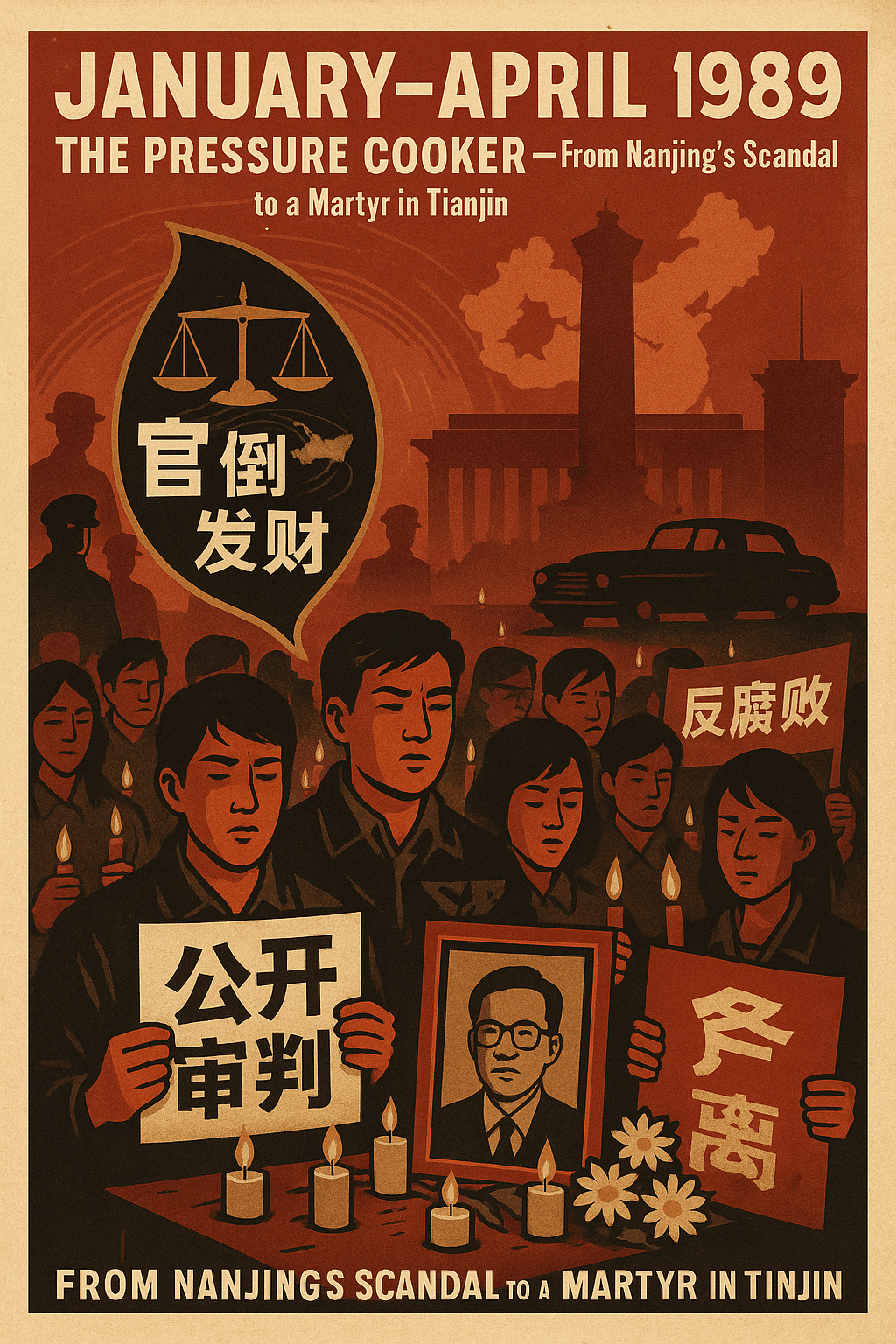
January 1989 – The pressure cooker
The year began with the same ingredients that, in our timeline, would brew unrest:
- Inflation still high after the 1988 price reforms — officially 14%, unofficially higher in urban markets.
- Urban discontent from ration cards being phased out in some areas, leaving poorer families exposed to price spikes.
- Student restlessness since the 1986 protests; they hadn’t been crushed, only corralled, and the networks still existed.
- Corruption rumors, especially the lingering memory of the Harbin Price Bureau leak, which had become a kind of urban legend: some cadres knew when prices would rise, and got rich while everyone else queued.
What was different was that Hu Yaobang was still General Secretary. Deng Xiaoping had resisted repeated grumbles from Wang Zhen to remove him, partly from sentiment, partly from a lack of better options. This gave students a living symbol of reform inside the Party — not a martyr, but a potential ally.
The new spark – March 1989, Nanjing Incident
In early March, the provincial newspaper Jiangsu Daily quietly published a short investigative piece — remarkable in itself — about a municipal Party secretary in Nanjing who had arranged state land transfers to a cousin’s private construction firm at far below market rates. The piece was dry, with no names, but sharp-eyed readers connected the dots: the “cousin” was married to the secretary’s niece, and the land was in a prime riverside district.
At first, it looked like a minor local scandal. But a group of Nanjing University students — many of whom had cut their teeth during the 1986 marches — reprinted the article as leaflets with a headline that boiled the story down to four explosive characters: 官倒发财 (“Officials Get Rich”).
Domino effect – spreading outrage
By the third week of March, copies of the leaflet were showing up in Wuhan, Shanghai, and Beijing. What made this catch fire in 1989, more than in reality, was the Harbin memory: people linked the Nanjing case to the idea that Party insiders had privileged access to information and resources.
In Beijing, Beida and Tsinghua students held small forums under the banner of “anti-corruption and anti-inflation” — a pairing that united both urban middle-class anxieties and worker resentment.
Hu Yaobang, privately sympathetic to the anti-corruption angle, told aides that “public anger on this point is legitimate” but insisted demonstrations should be kept small and peaceful.
The conservatives smell opportunity
Wang Zhen, who had been politically sidelined by illness in late 1988, returned to the capital with renewed energy — and an old soldier’s instinct for seizing ground. He argued in Politburo meetings that the Nanjing leaflets were “just the first shot” in a campaign by “bourgeois liberals” to undermine Party authority.
He wanted arrests. Bo Yibo, ever the tactician, counseled patience: “Let the fish swim closer before we cast the net.”
Deng listened but didn’t commit. The truth was, the corruption framing made this more dangerous than 1986 — it appealed to workers, shopkeepers, even small-time Party members, not just students.
April 1989 – The slow build
By early April, rallies had broken out in Nanjing, Shanghai, and smaller ones in Beijing. Students carried banners calling for 公开审判 (“public trials”) of corrupt officials, not for overthrowing the Party — but they chanted Hu Yaobang’s name as a “clean leader” and reformer.
This created an awkward triangle:
- Hu was being hailed as a hero by protesters, even as his position inside the Party was weakened by the optics of being “their man.”
- Deng saw the protests as a warning — not yet a mortal threat, but a reminder that public faith in the Party was brittle.
- Wang Zhen saw his chance to push harder against both Hu and Zhao, using the unrest as proof that reforms had gone too far.
15 April 1989 – The trigger in this timeline
In our real history, Hu’s death on this date was the spark for the Tiananmen protests. Here, he was alive — and it was a different death that triggered the wave.
That morning, news broke in Beijing papers: Zhang Weiguo, a 42-year-old investigative journalist at China Youth Daily, had died in a car accident on the outskirts of Tianjin. Officially, it was “due to brake failure.” Unofficially, everyone knew Zhang had been investigating land deals in Nanjing — the same scandal that started the leaflets.
Whether the crash was an accident or not didn’t matter. On campuses, whispers spread fast: they silenced him. By afternoon, Beida students had drafted a call for a memorial gathering in Tiananmen Square “to honor the truth and the courage to speak it.”
The date — April 15th — was now burned into their plans. In this timeline, it wouldn’t be a mourning for Hu Yaobang, but for a martyred journalist, and for the idea of speaking openly without being crushed.
| Name | Age (1989) | Faction | Position | Status During Nanjing/Journalist Protests | Notes & Background |
|---|---|---|---|---|---|
| Deng Xiaoping | 85 | Reform-leaning pragmatist | Chairman of CMC; Paramount Leader | Holding back both sides; refuses to remove Hu yet; worried corruption anger is broader than student unrest | Sees risk in both overreaction and passivity; last word on military intervention. |
| Hu Yaobang | 74 | Reformist | General Secretary of CCP | Publicly sympathetic to anti-corruption, privately urging restraint; conservatives framing him as “protester’s man” | Gains street popularity but loses political cover; careful not to be openly defiant to Deng. |
| Zhao Ziyang | 70 | Reformist | Premier of the State Council | Managing inflation fallout; reluctant to back crackdowns; focuses on economic stability | Balancing reform agenda with Deng’s caution; wary of being next conservative target. |
| Wang Zhen | 79 | Hardline conservative | Vice President of PRC | Back from illness; leading push for arrests; paints protests as subversive threat | Uses unrest to rebuild conservative momentum; cultivates ties with security apparatus. |
| Bo Yibo | 81 | Opportunist/Neutral | Vice Premier (Economic Affairs) | Advises “waiting for the fish to swim closer” before decisive action | Positions self as strategist; ready to tilt conservative if Deng signals green light. |
| Chen Yun | 84 | Conservative economic planner | PSC Elder (semi-retired) | Frail but supports Wang’s calls for tighter control | Maintains influence via letters; warns Deng of “letting the pot boil over.” |
| Peng Zhen | 87 | Centrist institutionalist | NPC Chairman | Calls for legal approach to corruption trials | Wants controlled public hearings to calm unrest without losing Party control. |
| Yang Shangkun | 82 | Military-leaning centrist | Exec. Vice Chair of CMC | Keeps PLA on alert but under Deng’s sole command | Ensures military stays out until Deng orders otherwise. |
| Li Peng | 61 | Younger conservative | Vice Premier (Infrastructure Oversight) | Sees unrest as vindication of his past warnings; quietly supports Wang’s hard line | Still politically frozen after 1987 failure; testing if crisis can restore his standing. |
| Li Ruihuan | 55 | Reformist rising star | Party Secretary of Tianjin | Praised for calm handling of price unrest; discreetly sympathetic to anti-corruption cause | Gains reformist credibility; popular among urban workers. |
| Qiao Shi | 65 | Reformist pragmatist | Head of Central Organization Department | Strengthens cadre discipline to avoid more scandals | Close to Deng; used to block conservative appointments in key provinces. |
| Zhang Weiguo (deceased) | 42 | Independent reformist voice | Investigative Journalist, China Youth Daily | Death becomes symbolic trigger for protests | Known for exposing land deal corruption; his “accident” fuels martyr narrative. |
 What If: The Archive
Leave a comment