May 5–7 – Negotiating the Forum
Hu Yaobang had barely returned from his morning brief when Zhao Ziyang came in without knocking. Zhao’s face was taut; his file folder was already open.
Zhao: “We can’t keep swatting at the edges. Approve a live dialogue. The whole nation will see us listening, not hiding.”
Hu: “And you think they’ll stop camping in the Square after that?”
Zhao: “If they have nowhere to grow, they’ll fade. Right now, we give them oxygen by ignoring them.”
By afternoon they were in Deng Xiaoping’s study, maps and incident reports on the table. Zhao’s arguments were crisp:
- Televised dialogue = optics of openness.
- Channel protests into concrete demands.
- Announce anti-corruption trials right after.
Hu nodded along, adding his own point: “If we don’t speak now, they’ll tire of waiting and turn to deeds.”
The conservatives were summoned the next day. Wang Zhen exploded before Zhao finished his first sentence. His teacup slammed down hard enough to splash the tablecloth.
Wang: “Put them on television? You make them heroes. Then we’re the villains begging for mercy.”
Bo Yibo was more measured, fingers drumming: “Why not filter the representatives first? Closed doors, no cameras. That way we choose the players.” Deng leaned back. “Closed door first, then we’ll see,” he said.
Hu and Zhao knew it was a procedural trap — but a trap with a crack in it.
May 8–10 – First Cracks in Unity
May 9, Great Hall of the People. Twelve student leaders filed into a side chamber — a bare, high-ceilinged room smelling faintly of old varnish. Hu, Zhao, and three ministers sat opposite them.
The students had rehearsed their three demands:
- Public trials for officials tied to the Nanjing land-deal scandal.
- Press freedom guarantees for investigative reporting.
- Reversal of black marks on students punished after 1986 protests.
Hu took notes, his pen moving steadily. “Some of this we can study. Some we can act on quickly. But you must have patience.” Zhao leaned forward, voice warm: “Reform is our shared project. The pace must be steady, or we all stumble.”
The students left respectful but unconvinced. They wanted the real thing — cameras, microphones, a nation watching.
That night Hu told Deng: “If we stop here, the Square grows.” Deng didn’t argue. He just lit his pipe and stared at the smoke.
May 11–12 – Hunger Strike Looms
Rumor spread: hunger strike to start May 13, timed for Gorbachev’s visit. Foreign press already had crews in Beijing; the optics were impossible to contain.
For conservatives, it was vindication: proof that Hu and Zhao’s “soft line” had emboldened unrest. For Hu and Zhao, it was proof Deng had to green-light the broadcast before the world saw a silent, hungry Tiananmen.
Hu went to Deng’s residence on the evening of May 12.
Hu: “If we speak now, we cut the hunger strike at the knees.”
Deng: “Talk to Wang and Bo. If they agree, I won’t oppose.”
It was a dare. Deng knew they would not agree.
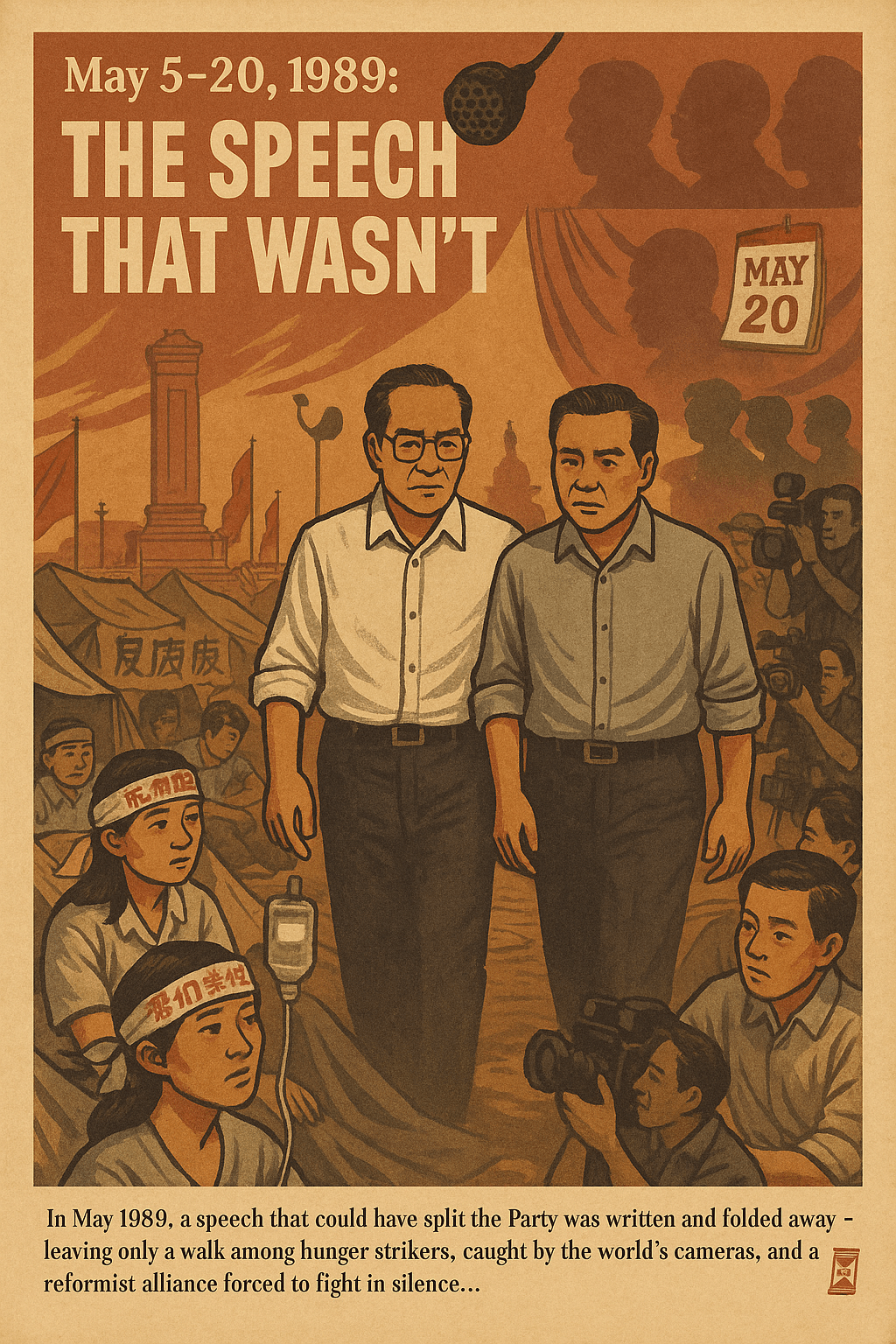
May 12 – The Speech That Wasn’t
Hu Yaobang sat at his desk in the West Building, the lamplight pooling over a single sheet of paper. On it, in his precise handwriting, was the opening to what could have been the most important speech of his life:
“同学们,你们的呼声,我们听到了。腐败必须整治,真相必须公开,中国必须向着正义与开放迈步。”
(Students, we have heard your voices. Corruption must be addressed, truth must be open, and China must step toward justice and openness.)
He imagined himself standing on the Square’s granite, wind tugging his hair, the microphones catching every word. The hunger strikers would rise; the city would exhale.
But then, in the quiet, he saw the other side — Deng’s still eyes narrowing, Wang Zhen’s cane striking the floor, the whispered accusation: “Hu has broken ranks.”
By midnight, the draft lay folded in his desk drawer.
May 13 – Zhao’s Offer
The next afternoon Zhao Ziyang arrived, tie loose, the exhaustion of days etched into his face.
Zhao: “If you can’t give it, I will. I’ll go to the Square and tell them myself. Let Deng be angry at me.”
Hu: “And split the reform camp in two? No. We win nothing if one of us survives without the other.”
He explained his reasoning — if one man spoke, the conservatives would have their pretext to drive a wedge, remove him, and then turn on the other. The only chance was to move together, but not on the stage the students demanded.
Zhao sighed, long and slow. “Then what do we give them?”
Hu’s answer was quiet: “Ourselves. Not speeches, but our presence.”
May 14 – The Walk
That morning, without announcement, Hu and Zhao left Zhongnanhai in the same black sedan. The security detail bristled; no schedule, no prepared press line.
In the Square, the hunger strikers lay under makeshift tarps, IV drips swaying in the wind. Hu crouched beside one young woman, her lips pale.
Hu: “Child, this is not worth your life. We will work for you — but you must live.”
Zhao knelt beside another student, listening more than speaking. The cameras caught it all — the two most powerful reformers in China, sleeves rolled up, bending toward the gaunt faces of their critics.
By evening, Hong Kong and foreign networks had the footage. In living rooms from Guangzhou to Harbin, people saw leaders not behind podiums but in the dust among the people.
Inside the Walls – Splintering Resolve
In Wang Zhen’s office, the tape played in silence except for the faint whir of the VCR. Wang slammed his palm on the table.
“They’re not General Secretary and Premier anymore. They’re opposition leaders in Zhongnanhai!”
Chen Yun’s reply came via letter, written in a trembling but unmistakable hand:
“If they are the people’s idols, the Party is already weakened. Contain before it is too late.”
Bo Yibo, in contrast, watched the same footage in his study and muttered to an aide:
“If they can calm the streets without troops, maybe it’s better for all of us.”
Even Peng Zhen, normally silent in faction fights, told Deng:
“The country is watching. If you strike them now, you may not be able to stop the wave that follows.”
The Students’ Side
That night in the tent city, the mood shifted. Many saw Hu’s and Zhao’s walk as a victory — proof the top heard them. Some whispered it was a trap, a photo gesture without action. The hunger strike committee split:
- Pragmatists argued to pause, claiming moral high ground and public sympathy.
- Radicals insisted to push harder: “If they can come here, they can promise here. Why else would they come?”
By dawn, the IV bags still hung, the banners still flapped. The pause never came.
May 15 – Gorbachev’s Shadow
As the Soviet leader’s motorcade rolled past, the Square was still full. The international press swarmed — split between photographing two aging revolutionaries shaking hands in the Great Hall and a sea of banners demanding freedom outside its gates.
Hu, watching the coverage late that night, felt both vindicated and trapped. The visit had turned into the students’ stage.
May 16–20 – Private Calculations
- Wang Zhen: Counting which regional commanders could be relied on if Deng gave the order.
- Bo Yibo: Keeping contact with both camps; telling each that the other might soon fold.
- Chen Yun: Writing a second letter, this one harsher, urging “order before openness.”
- Peng Zhen: Drafting a legislative compromise to offer public corruption trials without touching systemic reform.
- Yang Shangkun: Warning Deng that troop morale was brittle; any order would need political unanimity to avoid refusal.
Hu and Zhao continued to meet privately, agreeing to keep their unity invisible to avoid giving conservatives an easy narrative. They made no more public walks, but the image of them in the Square lingered — impossible to erase.
May 20 – Martial Law Preparations
Deng’s order was careful: mobilization, not deployment. Units near Beijing were to be ready, but no date for entry. To conservatives, it was a first step. To reformists, it was a delay worth taking.
Inside Zhongnanhai, no one could yet tell if this was the prelude to a crackdown or the final bluff in a long political game.
Outside, in the Square, the students argued, the tents swayed, and the summer heat began to rise.
 What If: The Archive
Leave a comment