May 21–23 – Martial Law Without Muscle
The martial law order went out in the afternoon, wrapped in careful language: “prepare to restore order,” not “move into the capital.”
On paper, three armies — the 27th, 38th, and 63rd — were to assemble around Beijing.
In practice, each commander read the political weather differently.
In the 38th Army headquarters, the commander flipped through the written order again, running a finger along the characters.
“No date. No operational plan. No political resolution. We wait.”
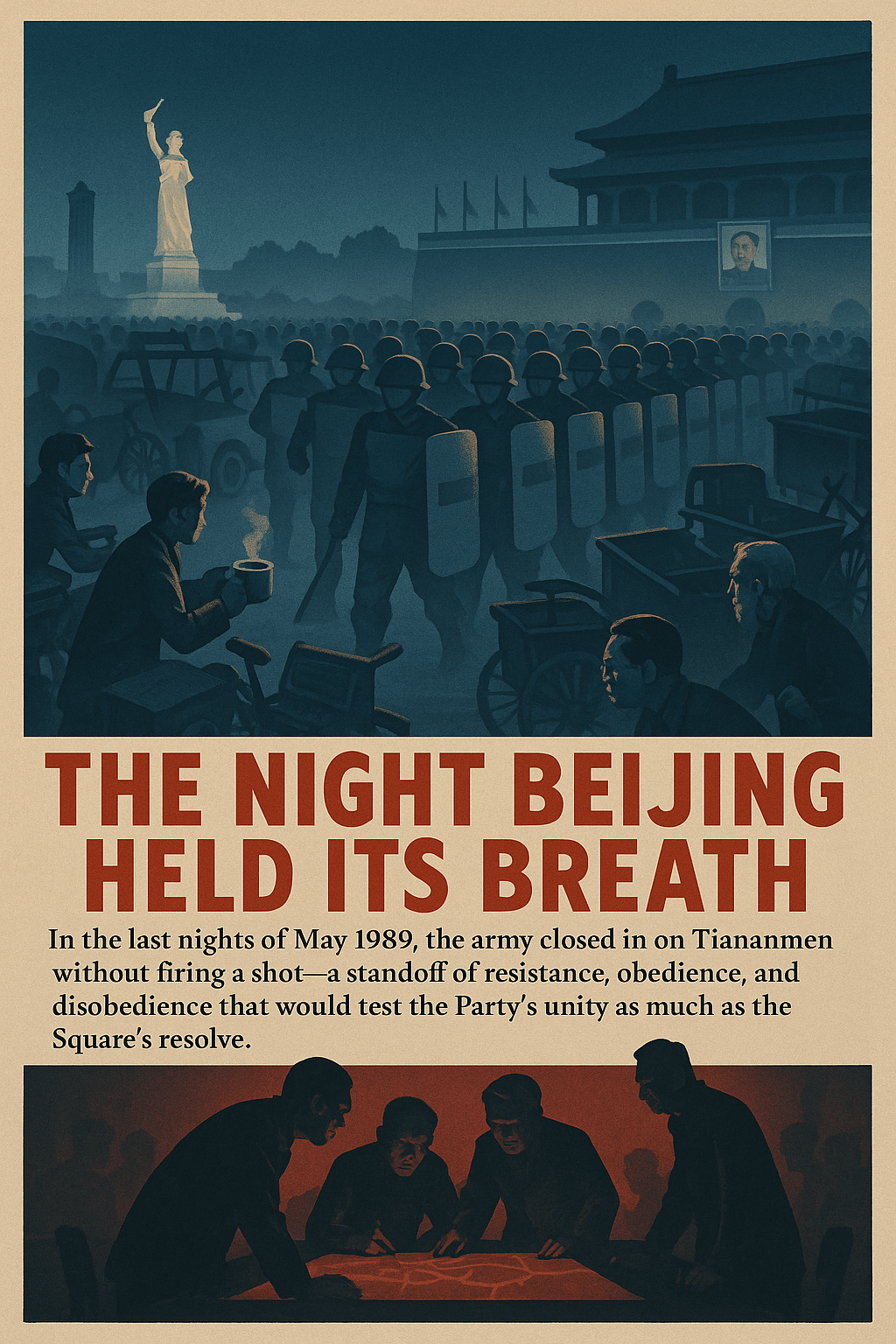
On the outskirts of the city, convoys crept forward, only to meet neighborhoods turned into improvised barricades — not with sandbags, but with baby strollers, vegetable carts, and clusters of retirees offering soldiers tea, cigarettes, and the occasional sermon on “how the army serves the people.”
Some soldiers laughed and accepted the cigarettes. Others shifted uncomfortably.
A few quietly said to the residents, “We won’t harm anyone.”
Inside Zhongnanhai, Hu used every day’s delay to push Deng:
“Once a bullet is fired, there’s no going back. Talk now, and the Square empties without blood.”
May 24 – The Conservatives Make Their Play
Wang Zhen called a closed-door session with Bo Yibo, Peng Zhen, and a handful of ministers from the State Council’s security wing.
Maps and attendance charts were laid out on the table.
Wang’s argument was blunt:
- The movement was no longer “student” — journalists, young cadres, and factory workers were appearing in the crowds.
- Hu’s image as “the people’s man” made the Square believe the Party would yield.
- A show of force before June would “cut the rot before it reached the roots.”
Bo Bibo, ever the opportunist, raised a practical note:
“Remove Hu and you need a face the people will accept. Zhao is too tied to the economy — not the security situation.”
The memo they drafted for Deng was a study in doublespeak: Hu to be “relieved for health reasons” and Zhao to be “acting General Secretary during the emergency.”
It was an attempt to cage Zhao while conservatives managed security.
May 25–26 – Deng’s Personal Crossroads
That night, Deng and Hu sat alone. Outside, the lotus pond was black glass.
Deng: “They cheer for you. That’s a danger — to you and to the Party.”
Hu: “They cheer because they think I’ll listen. That’s a chance.”
Deng: “A chance for them to learn they can make policy from the street?”
The words hung between them. Deng didn’t sign the memo, but his warning was ice-cold:
“If you can’t end this without blood, others will.”
May 27–29 – The Negotiation Gambit
Hu and Zhao convinced student leaders to meet on May 28 in the Great Hall. This time, the cameras were on.
A gaunt hunger striker described fainting in the heat. Hu leaned forward, listening, hands clasped. Zhao, taking notes, asked questions about their demands.
Hu announced three commitments:
- A national anti-corruption task force with student observers.
- Greater editorial independence for China Youth Daily and People’s Daily.
- No reprisals if they returned to class by June 1.
Cheers erupted in some corners of the Square. Others muttered: “Words without deeds.”
May 30 – The Goddess Rises
Art students unveiled the Goddess of Democracy before dawn, her white figure catching the early light.
To the radicals, it was defiance; to pragmatists, risky provocation.
For Deng, it was worse — a rival center of legitimacy, facing Mao’s portrait across the Square.
He told Bo Yibo quietly:
“This is no longer a protest. It’s an occupation of the people’s mind.”
June 1–2 – The Breaking Point
Deng called Hu in:
Deng: “You’ve kept faith with the youth. Now keep faith with the Party. Rest outside Beijing.”
Hu: “If I leave, it’s the signal for blood. I won’t be the one who clears the Square that way.”
That night, Deng signed a new order — transferring operational authority to the martial law command, bypassing Hu.
June 3 – The Split Command
Beijing was under dual power:
- Hu and Zhao’s offices still issued public calls for restraint.
- Martial law commanders, emboldened, prepared to move.
- Protesters, sensing danger, piled buses and steel pipes into barricades on Chang’an Avenue.
Foreign journalists saw tension but not the invisible mutiny: at least two field commanders told their units, “Push them out, but don’t fire unless fired upon.”
June 4, Dawn – Resistance, Obedience, Disobedience
The night before was unnaturally still. The air hung heavy, as if Beijing itself was holding its breath. In Zhongnanhai, the yellow light of the command room spilled across the polished floor. Maps lay spread on the long table, dotted with red and blue pins — each one marking a unit, a barricade, a street choke point.
The martial law commander stood stiffly at the head of the table, waiting. Hu Yaobang leaned back, arms crossed, his eyes fixed not on the map but on the clock: 00:47. Zhao Ziyang sat beside him, silent, flipping through a sheaf of reports. Across from them, Yang Shangkun and two senior generals loomed like immovable stone pillars.
The order on the table was simple in wording, impossible in consequence:
“Clear the Square. Secure order.”
It bore Deng Xiaoping’s signature, but with no explicit instruction on methods — a deliberate ambiguity that placed the final burden on those present.
01:15 – The Columns Move
From the western suburbs, the 38th Army began rolling forward — armored personnel carriers first, trucks behind. On Chang’an Avenue, the low growl of diesel engines joined the sound of boots on asphalt.
In the dim light, residents woke and poured into the streets.
Old men in Mao jackets dragged bamboo poles into the road. Women with infants on their backs pulled handcarts to block intersections. Someone overturned a bus.
Soldiers hesitated. The first human wall they met wasn’t students, but pensioners — holding enamel mugs, offering tea, saying softly,
“You are the people’s sons. You don’t harm your family.”
A few soldiers smiled nervously; others barked orders to keep moving.
01:42 – Alley Resistance
In narrow hutongs, the air turned sharp. Younger residents hurled bricks from rooftops. A stone cracked a windshield; a soldier inside muttered, “They think we’re here to kill them.” His sergeant snapped, “Eyes forward, no shooting.”
But in another alley, an APC driver swerved to avoid a pile of debris, tipping against a wall. The roar of the engine trapped in metal echoed like a gunshot.
Rumors flew ahead to the Square: “They’ve started killing!”
02:15 – Inside the Command Room
A messenger rushed in, reporting skirmishes at three points. Wang Zhen, called in from his residence, slammed his cane on the floor:
“This is what comes from softness. Push through!”
Hu shot back, voice low but cutting:
“Push through what? Your own countrymen? We agreed: no blood.”
Yang Shangkun’s phone rang. He listened, then glanced at Deng — sitting in the far corner, half in shadow.
Yang: “Comrade Deng, commander says movement is slow. They request clarity on ‘any means necessary.’”
Deng didn’t look up. “Tell them: the Square must be empty by morning.”
The room went silent. Everyone knew what those words could mean — but Deng’s tone made it clear: the choice was still the commander’s.
03:00 – The First Push
Troops reached the Square’s edge. Students, forewarned, locked arms in front of the Monument to the People’s Heroes.
The soldiers advanced in slow, disciplined steps, plastic shields forward. They shoved, prodded, grabbed — but the rifles on their backs stayed slung.
Some students shouted insults; others sang the national anthem, their voices breaking. One officer whispered to a protest marshal: “Move your people back, or there will be injuries.”
03:37 – Mutual Hesitation
Near the southeast corner, a soldier slipped, his baton clattering to the ground. A student bent, picked it up — and held it out to him, handle first. The young man took it with a stiff nod.
Small moments like that passed unseen by cameras, but they multiplied — tiny fractures in the narrative of enemy and ally.
04:10 – A Quiet Intervention
Hu called the field line himself.
“This is Hu Yaobang. Hold your perimeter. Let me walk in before you advance again.”
The commander hesitated. It was not a formal order — and not from the CMC’s acting chair — but it was the General Secretary’s voice. Finally: “Ten minutes, Comrade Hu.”
04:28 – The Last March
Hu and Zhao entered from the west side, flanked by a handful of aides. Cameras followed, their lenses fogged with early morning damp.
Hu climbed the Monument’s steps, Zhao staying at ground level, speaking to clusters of exhausted students.
Hu’s voice, hoarse but steady, carried over the Square:
“It is time to go home. You have shown the country your courage. Let history remember you for avoiding blood as well as for speaking truth.”
Some cheered, some wept, others stood rigid in refusal.
05:00 – The Withdrawal
Lines of soldiers advanced again, but slower now, as the first groups of students filed away in twos and threes. The diehards stayed, singing until the sound was swallowed by the movement of boots.
By 06:00, the Square was cleared — not with gunfire, but with a grinding mix of persuasion, fatigue, and the knowledge that Deng’s order, if pushed further, might change tone.
Different Reactions inside Zhongnanhai
The Square was empty by mid-morning, the sunlight glinting off discarded banners and crushed water bottles. Soldiers stood in loose formation, their faces drawn. The television crews were gone; the real drama was now inside Zhongnanhai’s walled gardens.
Wang Zhen slammed his cane against the floor as soon as the door closed.
“The army was humiliated. We mobilized half of Beijing’s garrison, and they leave with flowers and songs in their ears. The people will think the Party blinks.”
Chen Yun, listening from his wheelchair, shook his head slowly.
“Once the people know they can stand and the troops will not strike, they will stand again. This will not be the last Square.”
Bo Yibo kept his tone measured, eyes flicking between Deng and Hu:
“It could have been worse. A shot fired, and we’d be counting bodies instead of banners.”
Hu Yaobang, standing beside Zhao Ziyang, spoke with quiet conviction:
“The Party avoided bloodshed. Whatever political price we pay, that is worth it.”
Zhao nodded:
“If we rule a nation in fear, we will never truly reform it.”
Deng Xiaoping said nothing in public. In the afternoon, he summoned Wang Zhen privately. They sat facing each other in the dim light of Deng’s study, the sound of a clock ticking in the background.
Deng leaned forward, his voice low, each word deliberate:
“If we shoot our children, we will never rule their hearts again.”
There was no reply. Wang’s knuckles tightened on his cane, but he did not argue.
Morning of June 4, 1989
Outside, Beijing’s streets were already returning to their daily rhythm — but the memory of the night, the rumors of what could have been, and the images of leaders walking among the protesters would remain in the public mind long after the tents and statues were gone.
 What If: The Archive
Leave a comment